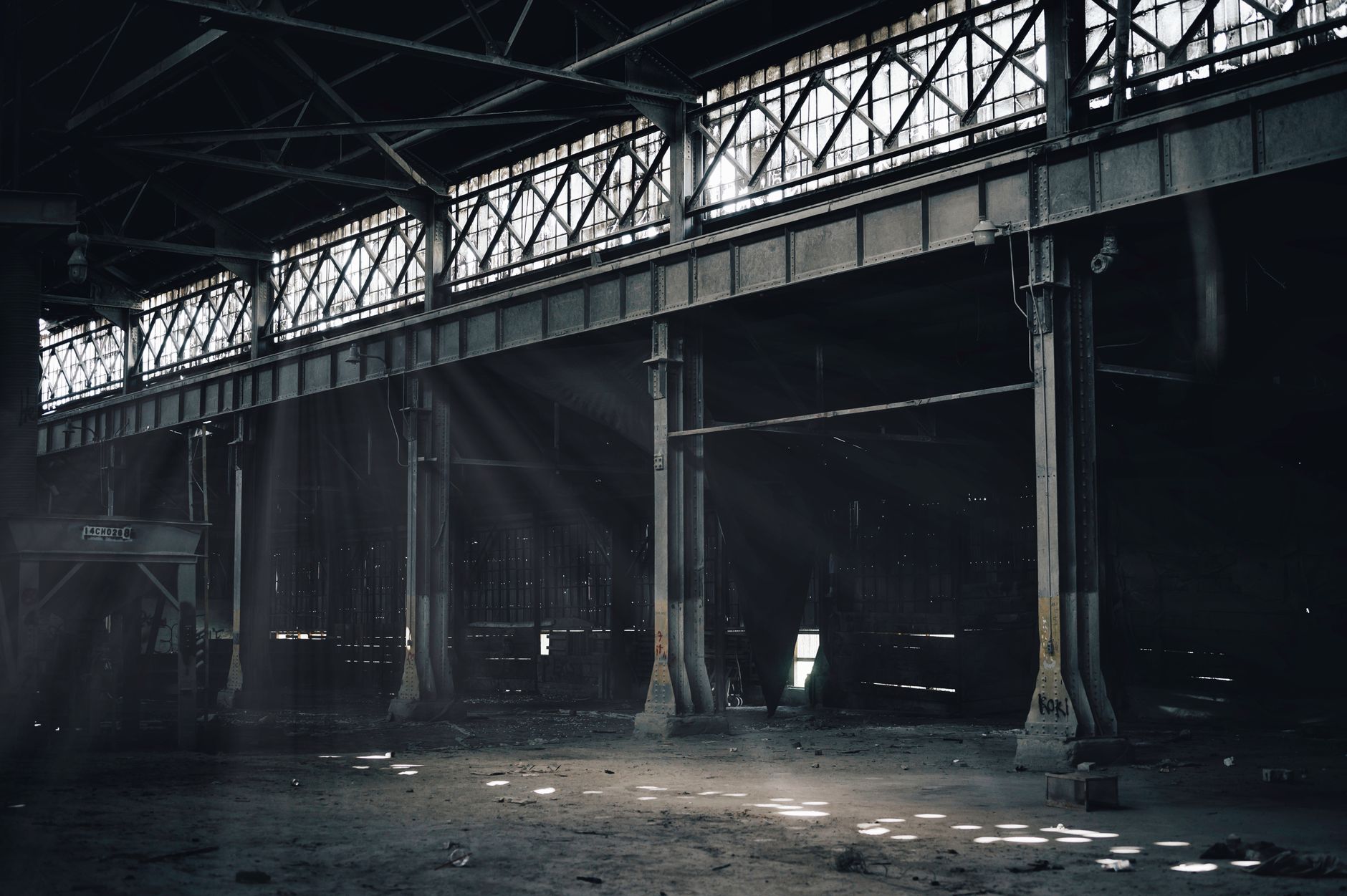
The extinguisher at the B end went first.
Its bracket still held the service tag, punched and signed, dated March. The fitter who came for the six-month check ticked both extinguishers off his sheet without looking up, and when I made him look, he stood a while with his pen in his mouth and then wrote replaced ’94, my own hands in the margin where the notes go. He’d been coming eleven years. He signed it himself.
Rennick, who’d kept the Vauxhill watch before me and was keeping it beside me until they signed me off, blamed the marsh. Doors, mugs, buckets of jointing compound — everything walked off the marsh edge in the end. Thirty-one years at the station, and he had a story for every object in the hall.
The headphones went in the second week of the works. One of the pair, off its hook by the operating desk, lead and all. Nine nights later the other followed it. Rennick held the empty hook up to the light, turned it over, put it back.
“They go in twos,” he said, and laughed at himself, and went to the stores for the spare pair.
I started a list in the back of my readings book after that. I know how it looks — an acting engineer, two months short of his grade, logging lost property like a schoolboy. But the plant is built in pairs. That’s the whole art of it. Main and standby. Forward and reflected. Left and right. Day pattern and night pattern. Two men for the switchgear room, because the rules say a man alone on 415 volts is a dead man waiting for a date. Take away one of anything and the twin is supposed to carry you to the next delivery. Redundancy, Rennick called it. Margin for one mistake.
Something was spending our margin.
The Stores Book
The boxed spare for the number-two meter left its shelf between one shift and the next, box, wrapping and all. Eleven days later the meter itself came out of the panel — not dead, not dark, gone, a cut-out hole with the screws lying in the bottom of it. We derived the reading after that, forward power minus line losses, and the Authority accepted the arithmetic, because the Authority accepts arithmetic.
Then the spare finals. There were two, in their crates, one at either end of the stores shelf like bookends. One crate went. Rennick didn’t report it. When I asked why not, he said the paperwork for a lost final wanted a written explanation, and there wasn’t one he could put his name to.
The widow crate stood on the shelf six nights. On the seventh the shelf was empty and the dust lay in two rectangles.
I wrote it all down. Paired losses, and the gaps between them: nine nights, eleven, fourteen, seven. Never longer than a fortnight. Whatever went first, small or not, its other half followed inside two weeks. I tested it once, God help me — the canteen kept two kettles, and one went missing after the works men left a door open. I marked the date. The second kettle was gone in ten days, and nobody but me had logged that either kettle had gone at all.
The standby transmitter was the last thing to break its pair. It didn’t vanish. It was eaten — cannibalized part by part to keep the main running, its drawers emptied one shift at a time, until we were radiating on a single thread with nothing behind it but a cabinet of labels. Standby became a word. Just a word.
And Rennick put in his papers, because sixty-five is sixty-five, and the area office posted the roster for the last fortnight of the works.
NIGHT WATCH — VAUXHILL, 14–27 OCT. A. RENNICK (FINAL). S. HOLLIS. TWO-MAN RULE TO BE OBSERVED — SWITCHGEAR, MAST LADDER, ATU HUTS.
I read it twice. Rennick’s last night was the works’ last night. Both signatures on the final readings log, his and mine — the sign-off I’d been eating nights for. Read and witnessed. A pair.
And after the works, one man leaving, and one man staying on alone in a hall where everything that loses its other half follows it inside a fortnight.
I didn’t sleep much that week.
The Roster
I told the area office my mother was ill and I needed days. It was a good lie — flat, dull, hard to check, easy to feel sorry for. The superintendent looked at me over his glasses, because he’d sat on the board that gave me nights, and then he moved me to days and told me to mind her. The roster came back on the Friday.
NIGHT WATCH — VAUXHILL, 14–27 OCT. A. RENNICK (FINAL). M. GOSS (FROM MERROW RELAY). TWO-MAN RULE TO BE OBSERVED.
Goss had covered at Vauxhill once before. A widower from the relay station with careful hands and a car that smelled of pipe smoke. He shook mine on the fourteenth and asked what the hall was like at night, and I said quiet, and he said good, and Rennick showed him the chair that used to be mine.
I was on days. I took my readings in the afternoon and drove home in the light. On the twenty-seventh the works closed, Rennick signed his last log — both lines, read and witnessed, his writing on one and Goss’s on the other — and they had tea in the hall, and Rennick went home to Norfolk with a clock in a box.
The station went single-manned that night. Unattended operation was coming anyway; the licence variation was already drafted; the two-man rule was the last thing keeping two men at Vauxhill after dark. Goss took the watch alone.
He was gone by morning. Car in the yard. Coat on the chair. Half a roll of mints on the desk, and one glove in his locker — the left, good leather, its partner never found. The police walked the marsh four days, took the dyke with grappling irons, sent a rigger up the mast. I gave my statement with everyone else’s. Nobody asked why I’d changed shifts. Why would they. A man moved to days for his mother. It was in the file, flat and dull.
Even
They restocked the stores in November. New extinguisher, serviced and tagged. New meters, a boxed pair. Two finals in their crates. Headphones in their two bags on the hook by the desk. Everything matched. Everything came back even.
That’s the part I can’t put anywhere official. Not the losses — the evenness. Every count I take now closes. Two and two, two and two, down the whole plant, hall and huts and mast, and a balanced building means the books are shut. Whatever was taking from us was taking against something, and the account is settled now.
Settled by substitution.
The station runs unattended at night. I do the daylight rounds.
Goss’s glove is in my pocket. I took it out of his locker the day they let us back in, before the family came, and I’ve carried it since — one glove, left-handed, good leather, the last widowed thing at Vauxhill. As long as one pair in that building stays broken, the count can’t close. Or it’s only a glove, and I’m a man who owes a debt no ledger shows. Either way I take the readings. I write them down. I keep the odd thing odd.