The Rule
My father hauled milk over Winterton Moor for thirty-one years, and he handed me one rule for that road. In the haar, follow no lights. Park past the crest at Stony Rigg, engine off, lamps off, and let it close over you.
He never explained it. He gave me the second part the way other men said grace — lights in the haar belong to the haar, and the fog takes its time from somewhere. At sixteen I took it for one of his economies, like watering the whisky. At thirty I filed it under tailgating. You drive to a tail lamp instead of the road, and whatever the lamp does, you do two seconds later. Road safety with the paint scrubbed off.
I work evenings at Ashgrove, the residential home on the Staithe side of the moor. Shift ends at eleven; my son is in bed by half past. The moor road home is four miles. The valley road is nine, and it floods from Michaelmas on. The haar itself is no mystery — it comes off the sea in the afternoon and lies down over the top of the moor like a sheet over furniture, and the Staithe fishermen set their clocks by it.
Stony Rigg is the crest above the old quarry, where the road bends left and a gravel layby runs about forty yards. In my father’s day the milk lorries sat nose to tail in that layby on haar nights, dark, and the fog went over them and down the far side, and nobody hurried it.
He retired on a bad hip and sat by the window for three autumns with the radio on. From that window he could see the Rigg, a grey nick in a grey hill.
Eleven Minutes
The first night I followed a light was the fourteenth of October. The haar beat me up the moor; past the radio mast my headlamps turned and came back at me, less weather than wet wool. My son would be asleep by half past. Nine minutes of road, then the bedroom light I leave on for myself in the kitchen, and the kettle.
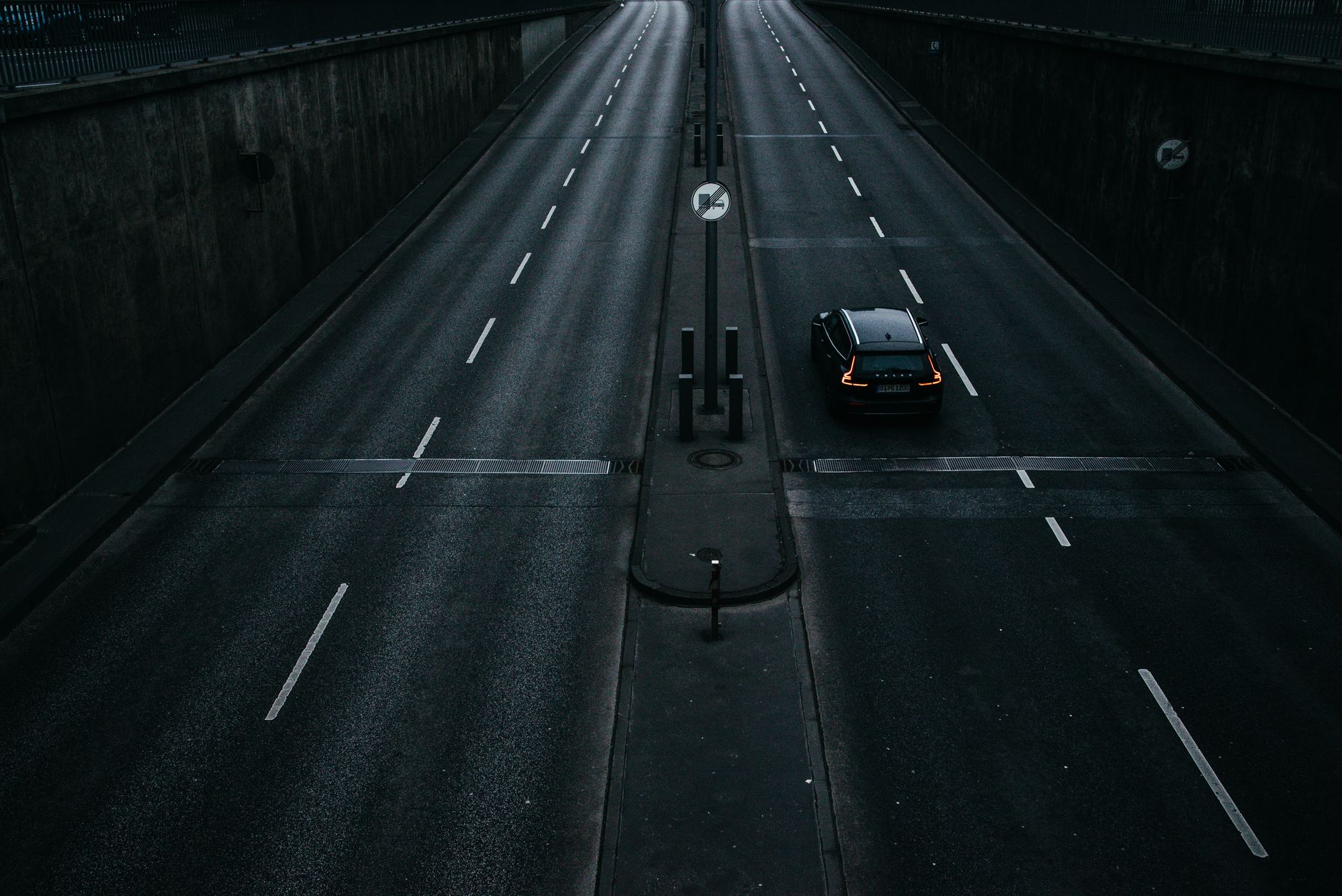
A hundred yards on, a tail lamp. Two, low-set — an old car, or a van. It ran at thirty, dead steady, and I did what you do. I dropped back to a following distance and matched it.
Up the long straight. Through the cutting. Over the Rigg, where the layby gravel whispered under the offside wheels. At the mouth of the old quarry road the guide’s right indicator ticked on, twice, and ticked off again. Unhurried. A man signalling his intentions to nobody, at a turning that had been closed since before I was born.
Eleven minutes, Ashgrove gate to my kitchen, by the clock over the stove. Four miles of it in fog. The kettle hadn’t lost its hum.
Nothing happened. That is the whole of that night: nothing, and eleven minutes.
The Round Book
Through November I used it. Not every night — the haar comes and goes — but every haar night there it was, or a light like it, running the moor at thirty, and I sat behind it the way you sit behind a bus. I told myself what any of us would. Locals know the line of the road. The indicator at the quarry is habit, an old hand remembering a junction that isn’t there any more.
The odd part was the radio. My clock stopped being able to describe the moor. Eleven minutes, nine, once fourteen, the same programme running start to finish — and I could not have said whether the fog was thick or thin in the middle of it, because I had stopped looking at the moor. I was driving a lamp.
My mother died in the first week of February. Between the funeral and the house clearance I found his round book: a hardback tally, Gorran Dairies on the cover, a page to a week for thirty-one years. First farm, last farm, depot. He kept it in pencil, in a hand you could set type by.
Most pages were work. But on haar nights there was a little caret mark after the depot time, and some of those lines did not add. On the worst of them the depot time ran before the first farm — half an hour before, twice an hour before — and in the margin, in my grandmother’s hand, on one page from before I was born:
Depot clock checked by the pips, Wednesday. Right twice.
I did the arithmetic a dozen ways. Clocks run wrong; pencils run fast. But he was not a man who arrived anywhere early, least of all the depot, where early meant standing in the yard with the other drivers while the sky got light.
After a certain autumn the carets stop. Twenty-two years of pages, no mark, no comment, nothing at Stony Rigg in the tally but fuel. Whatever he had followed, or whatever had followed him, my father parked dark on the Rigg for the last twenty-two years of that job, five nights a week in season, and waited the haar out with the rest of the lorries, and called it nothing.
He died nine years ago. I had always meant to ask him about the caret nights.
Stony Rigg
The April haar comes up warm off the water; the fishermen call it the silk. It was silk the night the home’s phone lines went down and a resident’s daughter drove in from Tregale and everyone’s evening went to smoke. I left past midnight. My son was fourteen by then, still up.
The guide was there, and I knew its lamp the way you know a bus route. Thirty up the straight, thirty through the cutting, and I settled in behind it — and at the quarry mouth my own right hand flicked the indicator stalk. Not deciding to. The way you signal a drive you have done a thousand times, except that I had never once taken the quarry road.
Behind me, two seconds back, headlights.
They had been there a while. A small car, riding my lamp the way I rode the guide’s. When my indicator ticked off, theirs ticked on. Right. Then off.
Thirty to the quarry road, if we held our line. My foot came off the accelerator. There are two things a driver can do at the Rigg, and my father had left me one of them, the half he could say out loud, and I had never once asked what the rule was for.
I pulled into the layby past the crest, all four wheels over the white line, and killed everything. Engine. Lamps. The heater fan. The dashboard went out like a held breath.
The small car pulled in behind me.
It sat there. In the offside mirror its lamps made two balls of silk, and then its right indicator started, tick, tick, patient as the guide’s had ever been — an old hand’s habit, a turning remembered for somebody.
The fog closed over the both of us.
I want to say it waited an hour. It was probably four minutes. Then it rolled out of the layby, easy, thirty, and its lamp shrank into the silk toward the bend — the left bend, the road, the road — and I watched the mirror until there was nothing in it but my own breath. I never saw whether it took the quarry. I have kept it that way on purpose. A body could look it up; the Tregale Advertiser keeps its motoring brief. I have chosen not to be a person who knows.
The rule has a second half. I have written it into his round book, in my own hand, under his last tally. Follow no lights, and give none to follow. My son starts his licence in the autumn, and he will get it the way I got the first half: said once, explained never, filed under road safety, because that is what it is, and because that is not all it is.
Haar nights I park past the crest at Stony Rigg with everything off, and the fog goes over the top of me and down the other side. Most nights something creeps past. Some nights something stops behind me and waits, patient as weather, with its right indicator going, and I sit in the dark and give it nothing, and after a while it goes.
The eleven minutes are in the round book too, now. In pencil. Under a caret of my own.