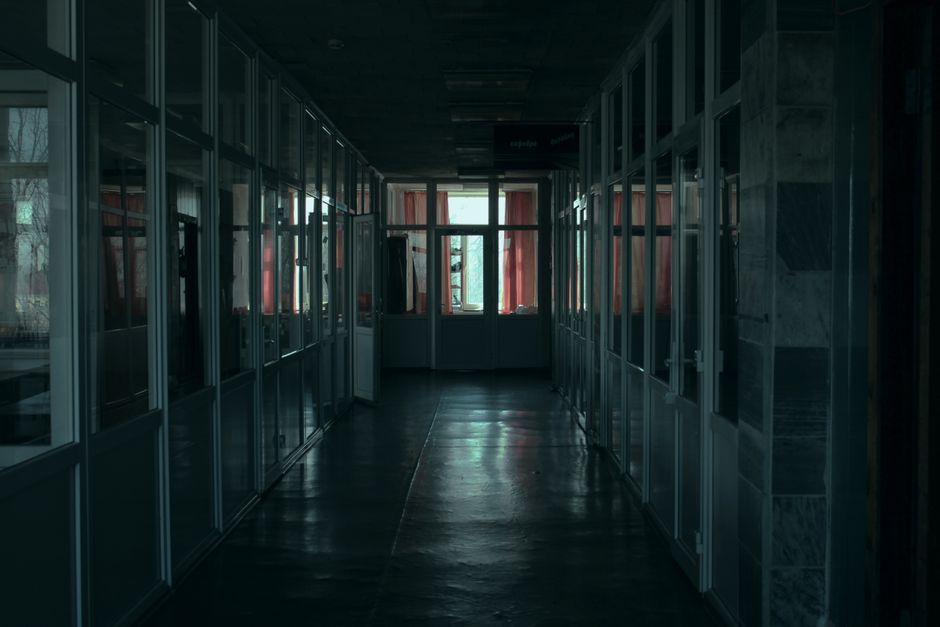
The Sanding Sound
The sanding started at ten past five on a Tuesday morning, a dry, patient rasp inside the wall of the spare room. I lay still and worked out which of our neighbours would be renovating at that hour. None of them would. The rasp travelled along the wall with the rhythm of a hand doing a job, and then it stopped mid-stroke, the way work stops when a person decides to answer a question honestly.
Dennis had left for the bakery at four, so the house and I had it to ourselves. When it quit, the ordinary silence of five in the morning came back in around the room.
The next afternoon I sanded that wall myself. Same rasp. Same little hitch where I lifted the paper to shake out the dust, in the same place, at the same speed.
On Thursday a paint-tin lid popped somewhere below the floor — the slow taut pop of a thumb working round a rim — and on Saturday my thumb found the tight spot at the same degree of the circle, and the lid gave, and I stood holding it while my heart did something stupid.
That evening I asked Dennis about it over the chips. He put his fork down, which he does when he’s deciding how much of something I’m ready for.
“That’s the house owing,” he said.
The Recipe Box
The box was his mother’s, a tin recipe box with a hinged lid, and it lived on the top shelf of the back room between the photograph albums. There were no recipes in it. Index cards, three generations of handwriting, and every card said the same kind of thing.
cupboard door, slam. 12 Jan 1954. Paid: same door, 6 p.m., no harm.
stairs, thud. Paid: Reader’s Digest, dropped top to bottom.
gate, hinge. Paid: oiled and swung by hand, twice.
The custom came with the house, and the house came with his grandmother. It plays sounds before the things that cause them. A knock arrives, and then, an hour or a week later, somebody’s knuckles make it. The family word for it was owing, because a played sound is a debt: give it a cheap cause quickly, before it waits long enough to find a dear one.
A thud wants a thud. Drop a book down the stairs and the account closes. His grandmother paid a whole winter of gate-hinges with a can of oil and a firm wrist. But the cards carried a second rule, underlined twice in his mother’s hand: a voice only pays in its own coin. You can fake a knock. You cannot fake a voice.
Through the spring we kept the box on the windowsill and settled up with the place like a couple paying a shared bill. The kettle’s climb-and-gurgle got paid by boiling it. The doorbell played on a wet Wednesday with nobody on the step; I pressed it myself, twice, for nobody. My mother came at Easter, slept in the finished spare room, and reported the house quiet. Guests hear nothing. The house plays for the household.
In June the sounds got longer. One Sunday it played a full minute of a morning that hadn’t happened: kettle, cupboard, a glass going over on tile, and — flattened by the wall into one hard syllable — a word in Dennis’s voice. We paid the kettle by boiling it. I broke a jam jar into the bin for the glass. Then Dennis took his coat, went out to the shed, stayed out there the better part of an hour, and came back with his throat raw. He wouldn’t tell me the word. Didn’t refuse, exactly. Said, “Mine,” and drank his tea with honey like a man after a football match.
I let it be. A voice only pays in its own coin.
Fourteen Minutes
The weeping came at three in the morning in late August, from the kitchen, and it was mine.
Not the polite crying out of a bad film. The industrial kind. Hiccups, begging, the flat ugly note of somebody who has been at it a long time and has stopped caring who listens. Fourteen minutes by the oven clock, unbroken, in my voice, in a kitchen with nobody in it. Dennis stood in the doorway with his arms out from his sides like a man at the scene of an accident. When it ended he sat down on the bottom stair, and after a while he said they wait.
His mother had one once. Nine minutes of a boy crying, played in February. She paid it the honest way: the family dog was put down that same winter, so she sat the boy down over the dog and let him cry it all out, every minute of it, and marked the card. Eleven months later his father went down in the yard between the bins and the gate, and at the funeral the boy felt all of it and produced nothing.
“I felt every bit of it,” Dennis said, thirty years on, in the same flat voice. “Nothing came out. Mam said the house had already had it.”
I thought about waiting. The cards said some waited decades, and now and then the cause turned out to be a sad film, or onions, or a wedding. But this had come in my voice, out of my own throat, and if it waited, it would be waiting to attach itself to something with a face — his, or my mother’s, or a child we hadn’t had yet. So I chose the Tuesday.
Dennis made tea. I sat on the kitchen chair and started with my father, dead since I was nineteen, and I fed that grief properly — the ward, the bus timetable of visiting hours, his hands — and when it ran thin I added my mother’s age, and the years, and everything that ends. It went past fourteen minutes. It went past by a lot, and I paid the extra on purpose, the way you overpay a bill you never want to see again.
Dennis wrote the card. His hand wasn’t steady.
the wife, weeping. 14 min. Paid in full, over.
The house went quiet — the deep working quiet a house manages when a debt has just closed. We drank the tea. It was past four in the morning, and it was August, and he was alive across the table from me, and the crying I would one day owe him had already been spent.
The Humming
In November, between his first cup of tea and his second, Dennis’s heart stopped. He was thirty-six. The ambulance men were kind and unhurried in the particular way that means already too late.
At the chapel I stood up when I was meant to stand. I felt every stone of it — the weight, the whole of him, the mornings, the way he said Mine about a word I’ll never know. My eyes stayed dry as a paid account. People put it down to shock, and then to strength, and I let them, because the truth was worse than either: the weeping had gone out of me in August, in a warm kitchen, with the tea cooling beside me. Nothing came. Nothing was ever going to come. The house had it, and had had it the whole time, before there was anything to weep about.
The first night back in the house alone, with the box still on the windowsill, the house played me one more sound. My own humming. Easy, unhurried, a good-morning tune, the kind I make over the toaster when the day has decided to be kind.
Somewhere ahead of me, it is already a good morning.
I took a fresh card and dated it.
the wife, humming. Cause: —
I left the cause blank, put the card in the box, and set out to grow into it.