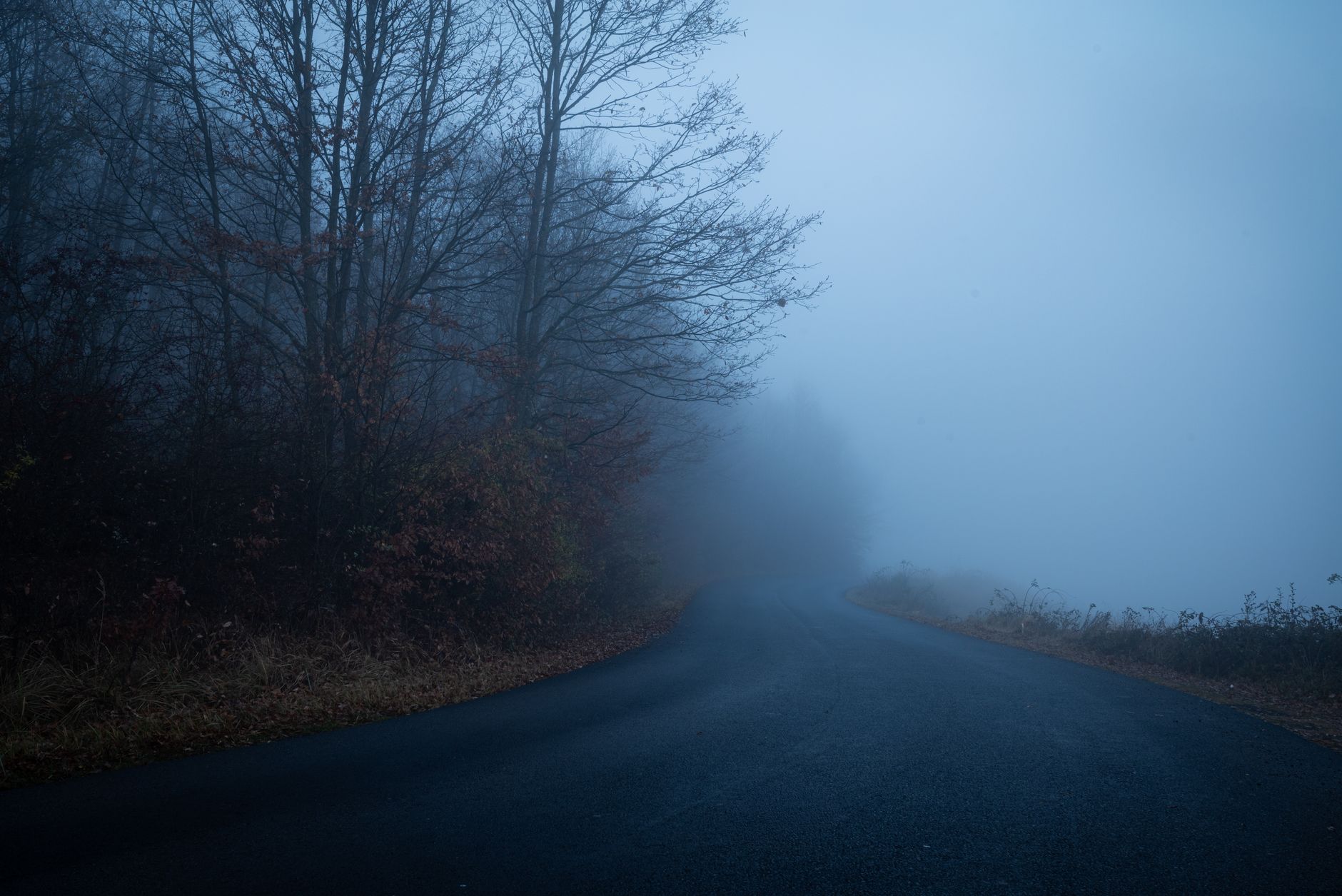
How Moira Tells It
Moira has driven the Marsk district rounds for nineteen years, and she told me the story at the start of my second winter, on the grounds that I was now doing Tuesdays and Thursdays over the top and ought to know. It came to her from her brother-in-law, who hauled aggregates over Annside Edge for six years, and he had it from an older driver whose name changes every time Moira tells it.
The shape of it stays the same.
First fog of October, any year, between half two and half four in the morning, on the stretch from the water board gate down to Marsk: a single amber beacon, the old rotating kind, running twenty miles an hour ahead of you. You fall in behind. You match it. You do not overtake, you do not flash your lights, and whatever happens you do not thank it — not out the window, not under your breath, not at the bottom when you’re through. It isn’t doing you a favour. It’s doing its job.
Those it brings down arrive at Marsk with their paint unmarked. On that much, every version agrees. The rest they argue about. Moira says you must watch the light and never your speedometer. Her brother-in-law says a taxi man overtook it at the Elbow once and was found two fields off the road, standing upright in fog so thick the searchers walked past him twice. Somebody’s aunt says the driver is a woman. A man at the depot says there is no driver at all, only the light, and is told to shut up, because that isn’t the story.
I filed it where I file most things Moira says. Fog, an old beacon on a highways truck, drivers pattern-matching their way home in the dark. I had Mr. Aldous and Mrs. Peake and the two bungalows at Pailings on my round, a fifteen-year-old hatch with a noisy heater, and one winter of getting over the top without an accident ahead of me. That was the whole of what I wanted.
The Fourteenth of October
The fog came down on the fourteenth, first of the autumn, while I was finishing the late round at Culerton. By the water board gate it stood over the hedges and I was down to second gear, windows cracked, listening for the gritter.
The amber light was already there. A hundred yards ahead, no more. Turning slow.
Twenty miles an hour. I know because I looked, and Moira’s rule about the speedometer turned out to be the one part of it I couldn’t keep.
What it did, it did well. It slowed a full fifty yards before the frost hollow at the Pailings — the dip where field water crosses and the surface glazes in October — and took the Elbow wide, out past the marker stone, the line you’d take if you’d driven the road fifty years and knew where the camber lies. Once, on the straight above Marsk, it stopped altogether and held, and after a moment a ewe came off the bank through my headlights and trotted ahead of us both for a quarter mile, the way a thing is seen home.
At the town boundary it was gone. No turn-off, no tail lights pulling away. The fog sat on the field above the allotments, the road ran empty and wet, and I was down.
I’ve tried to describe the following week and mostly I don’t bother. Minded. That’s the nearest word. Something with a far longer attention span than mine had taken an interest in my axles and my stopping distance — briefly, in passing, the way a council takes an interest in a bridge.
Six Days
In the third week of November the fog came back and stayed. Not for the morning. Not for the afternoon.
The county put the boards out on the Marsk road and local radio read the closure between the football and the overs.
PASS CLOSED UNTIL FURTHER NOTICE — POOR VISIBILITY
That was all it ever said. Below the Edge visibility was fine; you could stand at the top of Back Marsk and count Culerton’s streetlights with the barrier shut in front of you, and from the pub garden at Annside you could pick out stars. The fog sat on the pass itself, a mile and a half of it, gate to gate, like a held breath.
I ran the rounds by the valley road instead. Three hours each way, down past Weirton and up the far side, and I told myself the schedule would hold.
At four in the morning on the fifth day Mr. Aldous rang the bell at Pailings with the pain in his chest. I was there in nine minutes. The controller said fourteen for the ambulance and I said the pass was shut, and she said she knew, and neither of us said the other thing, which was that the helicopter sat weathered in at Culerton under the same fog that was holding the road.
The ambulance came the valley road with everything on. Somewhere above Netherfield the bends took the siren off. He was conscious when they loaded him at Pailings and not by Culerton. Chest pain, eighty-one, November fog. The word the inquest used was delay, and the delay was the road’s, and the road’s was nobody’s.
His son came down from Leeds and asked me, in the kitchen, why it had taken three hours to travel eleven miles. The pass was shut, I said. Poor visibility. He nodded and wrote to the county about signage, and I stood at his father’s sink and let the true half stand for the whole.
The Fortnight After
The fog lifted on the sixth evening, all at once, the way a hand opens. The county reopened the road at eight.
At ten past four the next morning the hillside above the Elbow let go. A slab the size of a delivery van came down across both lanes, onto empty tarmac, in the dark, with the first bus not due until twenty past seven. The gang had a loader on it by nine and one lane open by noon.
Moira took me to the local studies desk at Culerton library on her day off, and we went through the closures on the microfilm like two women doing a crossword. 1974: nine days of fog, then a fall at the Elbow the size of a wardrobe, a fortnight after. 1987: eleven days, a fall that took the wall and the marker stone with it. 2003: six days, then the rock on the front of the Marsk and District with a council man standing on it for scale. Every long closure, a fall after. Never once the other way round — no fall without the fog first, no car under a fall, no closure that ended without the hill paying out inside the fortnight.
At the public meeting in the institute, the county engineer brought photographs of the scarp and a quote for mesh and bolts. Three hundred thousand, unfunded. Somebody asked about the fog and he said fog was fog, you couldn’t bolt weather. Then an old man at the back — aggregates, Moira whispered, the brother-in-law’s old ganger — stood up with his cap in both hands and said: “You’ll not fix that bank, and you’ll not move that road. It’s held as long as it can hold, every time, and it’ll hold again.” He said it the way you give a character reference. The money was deferred to the next budget round, which in Marsk means no.
A week after the meeting, the new girl on the roster asked me about the amber light. She’d heard it at the depot, and was it true about the taxi man. I gave her the fog, the gate, the twenty miles an hour, the ewe. The shape of it. She wrote the rules on the back of her round sheet.
Mr. Aldous never came into it. I registered that afterwards, the way you register you’ve driven past your own gate: the story had set him down somewhere behind me and carried on walking, and I let it, and I’d let it again. It’s a good story. It brings people over the top with their paint unmarked, and it wants to keep doing that, and it can only travel light.