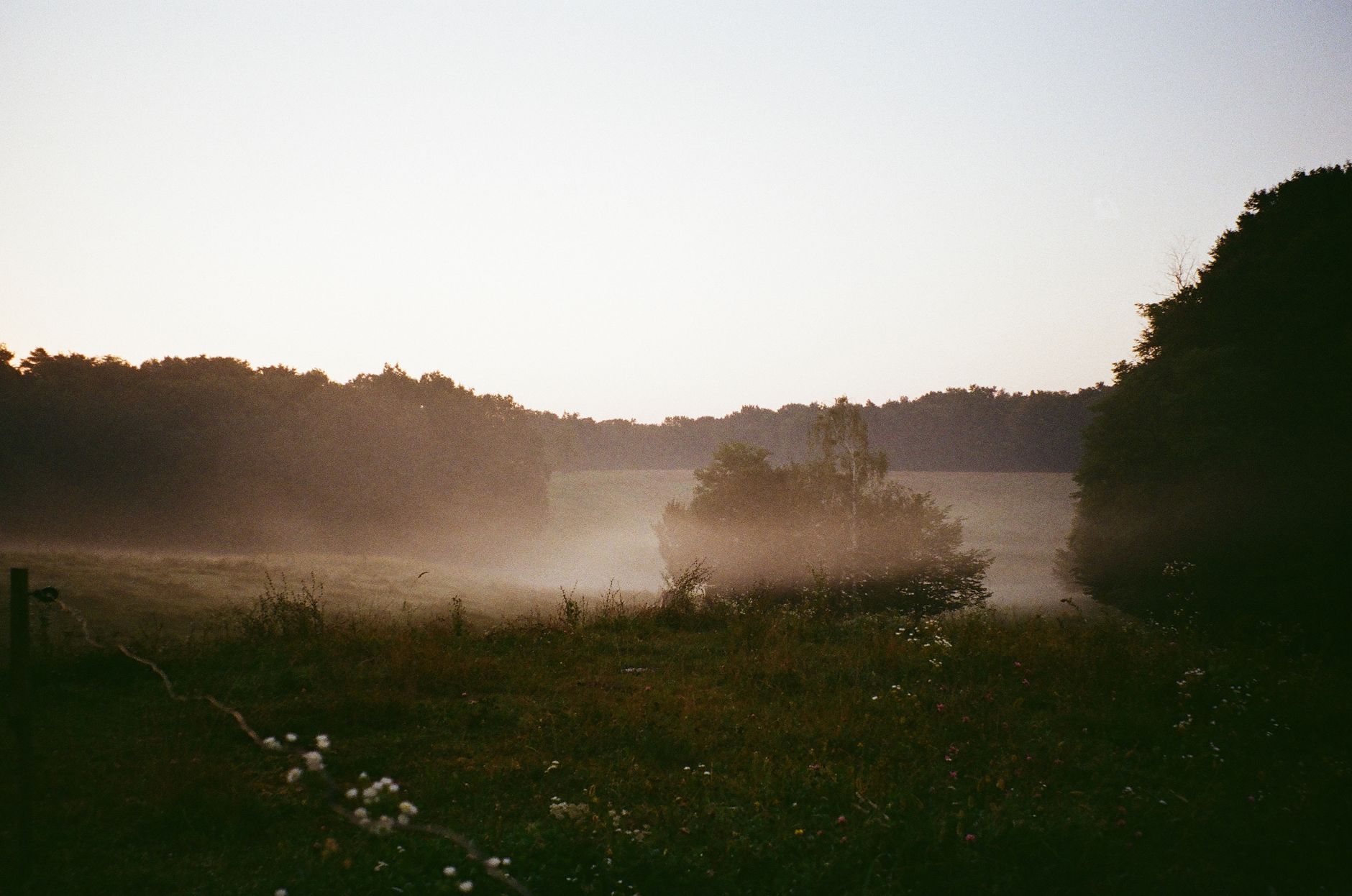
The county calls it the Area Lighting Rationalisation Scheme. Mick, who trained me back when the council still had its own gang, called it the lamp swap, and about it he had exactly one rule.
“Wethercote. You do the columns, the bollards, the church. Top House — the last place at the top — you leave the porch light alone. It’s not on our schedule. It’s not on our system. Leave it burning.”
I asked him why. Because it’s lit, he said, and that was the whole of it for three years.
The Unmetered Supply
Wethercote climbs out of its valley on a packhorse causey, setts down the spine and grass over the rest, and Top House stands where the setts give up: porch square to the track, a lamp on a bracket over the door, bracket older than the guttering. The supply comes off an overhead the electricity board lost the meter for in 1971. There’s a letter about it in the shop window, there longer than the current owner:
Re. Account 4/WC/1. The meter at the above address cannot now be located. Supply will remain nominal pending further enquiry. — North Western Electricity Board, March 1971
Nobody enquired. The load is one sixty-watt bulb behind glass gone amber with flies, and it burned on through the decades until the carbon audit caught it: unmetered, always on, an exception with no owner. The audit does not do exceptions with no owner.
Top House sold two winters back. Buyer in Manchester, holiday let, agency in the market town handling everything, and under the scheme every fitting on the estate goes PIR LED — cold white, motion only, daylight colour, as the manufacturer has it. The landlord signs his works notifications from a phone. I fitted B-14, a smart floodlight with an event history, on a Tuesday in March, and put the old bulb in my jacket pocket instead of the skip, because the skip was the wrong place for it.
For five weeks the sheet stayed clean.
03:04
The agency’s email reached the helpdesk in May and came to me as a comfort complaint. A guest had left at dawn. Two lines of it:
The outside light came on at 3 and stayed on for most of an hour. It was like being looked at.
B-14 pairs with an app. The app exports history. I sat in the van below the village and worked through it the way you work through a fuel log, line after line, night after night:
04 Mar 03:04 ON — 11 min
05 Mar 03:04 ON — 11 min
26 Apr 03:04 ON — 26 min
12 May 03:04 ON — 41 min
19 May 03:04 ON — no OFF until sunrise
Eleven minutes, every night, four past three, from the first. Then fourteen. Then twenty-six. A PIR holds its lamp while motion continues inside the arc, and the arc runs eleven metres: yard, step, the top of the causey. Runtime is only a measure of how long something keeps moving in there.
I drove up on the Saturday and walked the causey from the cairn. Setts, grass, then the five-bar gate into Top House’s yard, which the agency’s gardener chains every evening. The chain hung off its post and the gate stood open to the field. On the step, drying in the wind, two prints. Not paw. Heel and sole, silt from the top ground, pointed at the door.
The sheet got: cause — wildlife, likely sheep; action — sensor re-aimed. Both halves true enough to sign.
The Shop
The shop knows that light the way it knows the weather. For the packmen, one version goes; for the shepherds, says another; the oldest is the widow’s lamp, hung for a man on the lead veins who never came down, left burning, and the village kept it burning after her, and no telling has ever confirmed that everyone from the top is down. That’s the shape of the custom in every version: so long as that light’s lit, they can find their way in. Nobody finishes the other half of the sentence. I asked. The woman on the till rang my tea up wrong and looked at the biscuit shelf.
An old boy at the bench gave me the only detail that matters, and it wasn’t history. “That lamp never asked nowt,” he said. “It were on afore owt come, and on after. This’un asks.”
Walking down, I did the arithmetic I’d been refusing for a fortnight. Fifty years, Mick’s rule, the letter in the window: the promise was never that the light would come on. The promise was that it would not go off. A sensor cuts a promise in half and holds the question half out to the dark every night at four past three, and something out of the dark had begun answering, and the answers were getting longer. The county, when I checked that afternoon, had already raised a “persistent activation” fault visit. Two engineers. A ladder. Whatever hour the helpdesk likes.
Warm White
I went up on the Sunday before, early, with a key I’ve kept since the gang days and a tungsten bulkhead out of the crate under the bench. Warm white. No sensor in it anywhere, sixty watts of nothing clever. B-14 came off with two screws, the bulkhead went up on its own holes, a proper toggle switch inline, marked, and on. Then the asset record: B-14 removed, heritage exception, unmetered supply retained, reference 4/WC/1. The reference is a letter in a shop window. No system in the county holds that letter, so no system in the county can refuse it.
The audit closed in June with the exception granted, and if anyone up there remembers granting it, they haven’t called.
A lamp with no sensor generates no events. Nothing pairs, nothing exports, and every night since has gone unrecorded, and will for the life of the bulb. I kept the old history on a memory stick in the van door. I haven’t opened it. I’m not going to open it. Whether the walking stopped on the nineteenth of May or only stopped being counted is not a question my trade can answer, and Top House’s porch burns warm again in all weathers, which is how the shop tells it.
They tell it with me in now. Buying wire last month, I caught the tail of it: there’s a chap keeps that light wired old-style, does it off the books, ask for him if your sensor plays up. In their version he’s Mick’s age, lives at the top, lights it by hand at dusk. I paid for the wire and left every word standing. That’s how a thing like this gets kept. Not by me, and not by the app.
By a bulb, a lost meter, and a shop full of people who never finish the sentence.