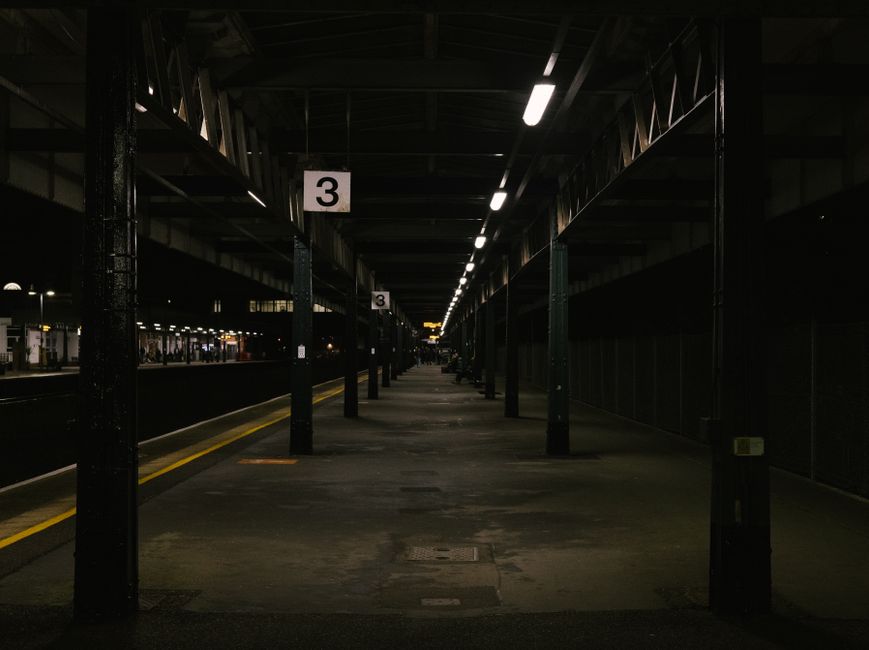
The Reading of the Meters
Every night at 23:40 the last Route 9 came down the ramp and stopped with its front axle on the chalk line, and the driver read his meters through the hatch to Miss Prewitt, who wrote the figures into a ledger with a fountain pen she filled from an ink bottle kept in the drawer. Rain, frost, the week of the power cuts; the ritual held. She had kept the mileage book since 1961, and she ruled a red column down the right-hand page with two letters at its head: DM.
I was twenty-three and relief driver, which meant I drove whatever sickness or holiday had opened up, and I wanted one thing in the world: Vince’s permanent nights on the 9. Vince retired in March to a bungalow on the coast he described in the break room the way other men describe paradise. The nights were mine to lose.
Route 9 ran nineteen and a half miles, town to Varldale Water and back, plus two miles of depot running. The last bus never came home on the arithmetic. Three over, five over; in October of ’84, eleven. Prewitt wrote the difference in the red column and carried it forward like a debt.
Dead mileage is a real term. Every operator uses it. Miles run out of service, carrying nothing — a bus dead-heading back to the depot after the last stop is dead mileage, legal and ordinary, a category. That’s the trouble with a category. It will hold anything you put in it.
The Rule from 1957
In April, Merlow & District passed into the North-Western Transport Authority. Men from the authority sat in Harnby’s office with the ledgers and found two hundred and fourteen miles in a year that belonged to no route the company owned. Harnby, who had inherited his rules along with the company, gave them the rule he had been given in 1957, when the valley went under and the old valley operator’s bookkeeping came across with its assets.
The excess was driven off. Once a quarter, out of service, one driver, no passengers, until the meter matched the red column. A settlement run. Then the books balanced.
The authority men said the word computers several times. Our ledgers transferred on Monday. Harnby waited until they were gone before he spoke to me.
“Vince did it nine and twenty years,” he said. “Sunday, two in the morning. Take the 9 out, run the route, then drive until the meter reads fifty-one over. Not fifty. Not fifty-two.”
He handed me a card, typewritten, soft at the corners from other men’s wallets.
SETTLEMENT RUN — OUT OF SERVICE
Dead mileage carries no passengers. No exceptions. Doors remain closed except at depot.
“Why me?”
“Prewitt has to enter a driver,” he said. “And you want the nights.”
Nether Holt, Alma Road
The town at two belonged to me and a cat. I ran the route out the way I knew it, the long climb past the cement works, the drop toward the water, and at the reservoir the new road forked away to the causeway as it always did. The barrier on the old alignment stood open.
It had rained the whole last week of September. The water was high. And the old road went on past the barrier, down where the map put the valley floor nine fathoms under — bare, dry, dust standing in its joints, and tyre marks laid across tyre marks, years of them, all of them the width of a bus.
The meter read forty over. It wanted fifty-one. I took the old road, because the old road was going somewhere and nothing else was.
Alma Road had been the stop at the head of the drowned village. The shelter stood at the bottom of the dip with its bench and its lamp, and the lamp was lit. I looked for the cable. There was no pole.
First pass I did not stop. The card sat on the dash, and I held the old road up past the shelter and round the head of the valley, and came back down toward the water with the meter at forty-nine. Two short. Beyond the dip the alignment ran on into standing water, and the tyres would not go where the map was right.
Second pass, there were people at the shelter. Four or five, in coats from the wrong decade, waiting under the lamp the way people wait who have been given a time by someone official. A boy of seven or so stood forward of the shelter at the edge of the road, where you stand if you have been told to stand where the driver can see you.
I stopped. Of course I stopped.
Nothing in the farebox took and the ticket machine printed nothing, and they came up the steps in order without paying, front seats back, the way regulars do. An old woman pressed a coin into my palm on her way past. Her hand had the cold of water in October.
Fifty-one of them boarded, and I know because I kept my eyes on the meter. It ticked as each one stepped up. One tick, one mile, fifty-one times, and then it stopped, and would not be moved by the engine again until I turned for home.
Fifty-One Over
They rode back across the causeway without a word between them. At the ramp the doors opened and they went out through the fog, up the streets of the new estate, unhurried, and the streetlights put a shadow down for each of them, one after another after another.
Prewitt was in the booth at four, in her coat; she came in for the settlement, always had. She read the meter, drew a line under the red column and closed it with a stroke that dug into the blotter, and wrote my name against it in full.
The coin was a shilling, 1956. I nailed it to the corkboard by the hatch, where found property goes. Nobody ever asked after it.
On Monday Harnby pinned up the rota. My name, nights, the 9. I had wanted them since March. That is what I told myself, taking them.
By Public Demand
The authority kept our ledgers after April and typed them into its machines, and in February the review came back down: on the night services, counted loads with no tickets issued. A conductor’s survey, a policeman’s report, a student with a clipboard. The loads were there and the fares were not.
An institution cannot write the word impossible. It writes the word demand.
The notice went up in the depot with the spring timetable changes:
From 1 April, the 22:10 and 23:10 services will additionally call at NETHER HOLT, ALMA ROAD, in response to recorded demand.
Nether Holt had been under the water since 1957. That spring the engineers drew the reservoir down for dam works, the first time since the flood, and the old road came up whole to the far shore. The stop appeared on the route map with a dot and a bolded name. It was in the book.
The first evening call fell to me. The rota said so.
They were three deep at the shelter and down the dip beyond it, patient, in coats from the wrong decade, and up the old high street behind them lamps were coming on in the houses, one by one. There are no wires on the far shore. There never were.
I set the blind: NETHER HOLT, official, printed.
The doors folded open, and the meter began to tick.