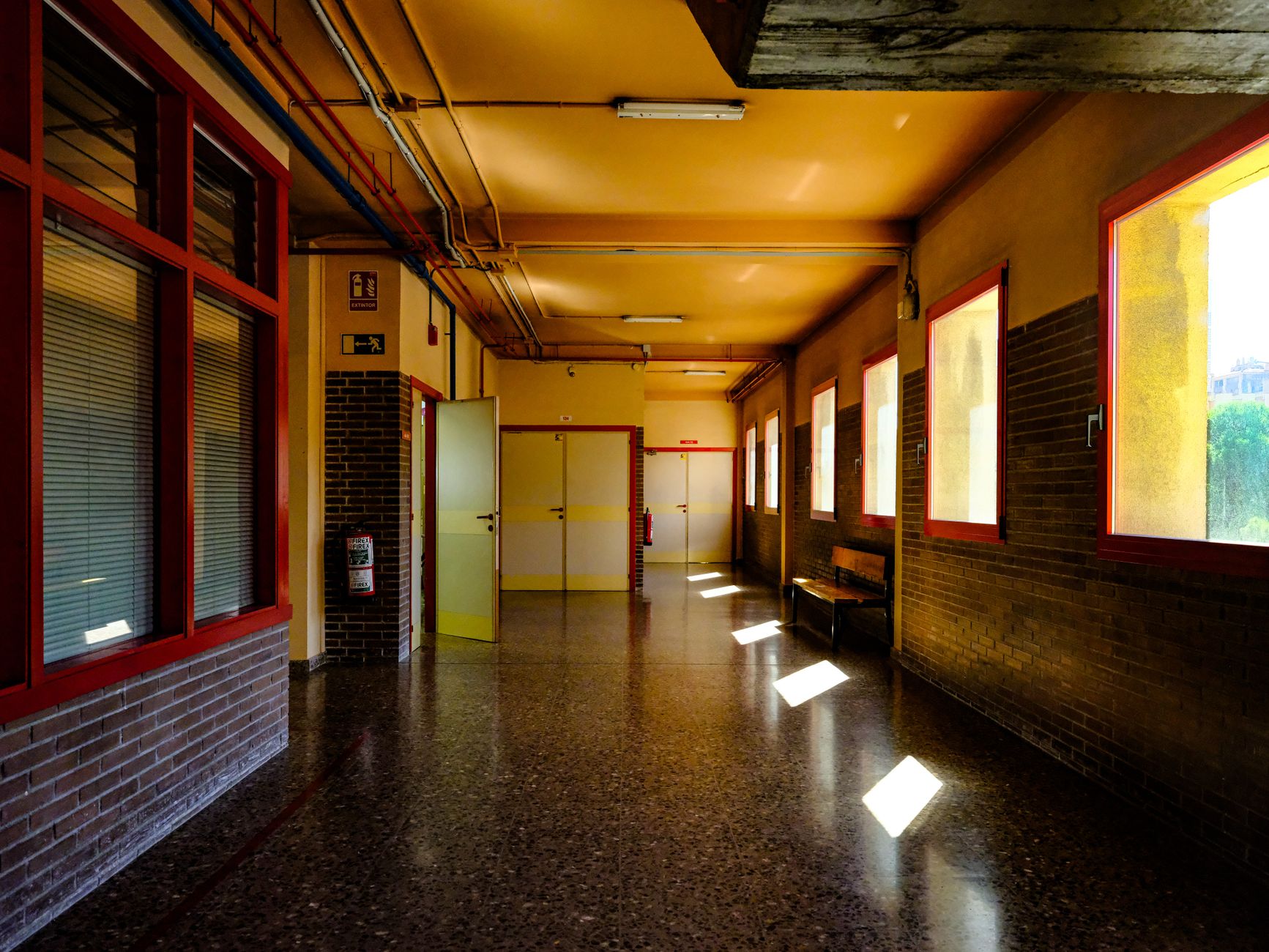
People at the water bureau tell the Delvin Street annex story the way counter stories always travel: friend of a friend, the branch nobody wants, the year before you started. I heard it that way myself, four weeks into probation, counting my till in the break room with the drawer still warm in my lap. I can tell you which parts I checked, and which parts I only keep.
The Take-a-Number Machine
The annex took water payments. Bill queries, meter disputes, shut-off appeals — one counter, one till, a glass window with a payment slot, and seven orange chairs in the waiting room. A take-a-number machine stood bolted to the wall by the door. Press the button, it printed your place, the display called you up. Empty rooms took their turn too. That was the first thing Diane taught me: the machine decides who’s next, never the clerk.
The second thing she taught me, she taught with the day’s stub roll folded into her palm, uncounted.
“When it skips a number, you let it go. Don’t call it. Don’t reissue it. Don’t stand there working out where it went.” She dropped the roll in the bin. “It belongs to somebody. Let them keep it.”
She’d had the rule from her trainer. Her trainer had it from a woman who was on the counter in 1974, the year a clerk called a skipped number and something came up to be served. The versions drift after that. In some tellings the clerk transferred to Records and that was the end of her; in mine she retired to her sister’s place in Tucson and wouldn’t take calls about water. Every version keeps the rule word for word, which is how you know it’s a work story and not just a story. Rules survive the people who break them. That’s the whole trade.
Diane had one more instruction. At 4:25 you turn the CLOSED sign and lock the till, and from then until the guard walks the room, you count with your back to the chairs. Whatever the door does, you count.
“You’ll lose something,” she said, on my last day of training. “Something small. Everybody who keeps the rule does. Cheap at the price.”
I was twenty-three and I wrote that down as color.
Sixty-One, Eighty-Four
My first skip came on a Tuesday in November at 4:12. The display said 60. The machine printed 62. Between the two of them a man sat down at the far wall — gray coat, cap, hands flat on his knees, holding nothing — and the room had been empty since lunch. I did what I was told. Turned the sign at 4:25, locked the till, counted the float with my back to the chairs. At some point the door opened, let the street in, and shut.
Next morning the stub roll read 58, 59, 60, 62. Not skipped over. Never printed.
You can rationalize that for a while. Machines misprint; I’d believed worse of that particular machine. What I couldn’t rationalize came that weekend, when my brother asked what I’d done with my first car, and I reached for the make and the reach came back empty. Six years I drove that car. The badge, the grille, the name of it — gone, clean, like a page lifted out while I was reading it.
Diane took it steadier than I did. “The make of a car,” she said. “Cheap.”
The second skip was in December, and it was worse in every direction. Number 84. An old woman took the middle chair at noon and waited with her coat buttoned and her hands folded. Nobody at the counter could produce the moment she’d taken a ticket, and her number wasn’t on anyone’s roll. She waited four hours. I turned the sign. I counted. The door never sounded, and when the guard walked the room for lockup her chair was empty, and on the seat lay a blank request slip, printed with nothing, the kind from the dispenser by the counter.
Diane filed it in the bottom drawer of the counter without a word. The drawer was half an inch deep in blank slips, the oldest yellowed to weak tea. It had been there since before her time, she said, and it had never once been full.
That winter I lost my college roommate’s name. I don’t know what Diane lost. I know the inside of her locker door was taped with photographs — every person who had ever trained her, labeled in ballpoint — and that she checked them the way other people check a scar.
Ninety-Seven
The third skip came in my last week of probation, at 3:50 on a Thursday, in a room that had been empty since one o’clock. The display read 96. The machine printed 98. And at the glass, at the bell, stood a child in a parka with the hood back and mittens on a string, small enough that the payment slot sat level with its chin.
No procedure covers children. I’d read the binder twice. Every version of the story agreed on the rule and none of them agreed on what the rule was for, and the permanent post was mine on Friday if I kept my nose clean, and none of that was why I did it.
It was the mittens.
“Ninety-seven,” I called.
The child crossed the room — the first of them I ever saw move — and a voice came through the slot thin as onionskin.
“The paper that says where I live.”
Behind the counter, past the active files, there’s a drawer marked PENDING in blue china pencil, and that day I pulled it for the first time. The card inside was half typed. The name was typed in full; I won’t repeat it here. The address read 44 Dellrose Avenue. The date-of-birth line was blank. Account status: open, never billed.
I certified it. That’s the whole of what I did — the same stamp I put on a hundred proof-of-residency copies a week, my clerk number in the guarantor line, which is the only signature the form asks of us. The certified copy came out of the machine warm. I folded it in quarters and put it through the slot, and the child took it in both mittens and carried it out the door into the four-o’clock dark.
The door closed on its own weight, the way it always had.
Dellrose Avenue
That night the daybook closed with a line in red ink:
97 — SETTLED — guarantor stamp 114
Red ink means settled. There was one other red line in that book, from March 1974, on a page nobody had touched since.
I passed probation. In February the north annex called about a standing account — 44 Dellrose Avenue, an empty house, water on, paid on the third of every month in exact change at their counter. They had a question about the deposit slips. The handwriting on every one of them was mine.
I drove out there on my lunch hour. Curtains open, no furniture, a tidy porch, and taped to the inside of the front-door glass, facing out, flat and unfolded, a certified copy of a proof of residency, certified by stamp 114.
I asked Diane once what a guarantor owes on a completed account. She gave me the answer she’d been given, and by then she’d guessed the number I was about to say.
“Whatever it draws.”
I keep a notebook now. Names, faces, the makes of every car I’ve owned, my mother’s voice saying my name spelled out phonetically so I can check it against the real one. I read it at night, the way Diane checked her photographs. Last spring I trained a new clerk, and out of my mouth came the rule word for word — it belongs to somebody, let them keep it — and halfway through the sentence I understood that I could no longer picture Diane’s face. Keeping the rule had been taking her from me all along, one detail at a time, the same as it took the car and the roommate’s name.
The rule is cheap. Every month Dellrose Avenue draws what it draws, in a hand like mine, and that night I read the notebook twice. I file the slips in the bottom drawer.
I do not call the number.