Seventeen Nights
June cried for seventeen nights. I counted, because at three in the morning counting was the only arithmetic I could still do: nights since her birth, hours since the last feeding, weeks until the boards.
The exam letter sat on the kitchen table in its plastic sleeve from the community college. March 14, 8 a.m., at the county fairgrounds. Forty dollars to reschedule, six months’ wait if I failed, and six more months of second-shift aide work lifting two hundred pounds of Mr. Ganzer off his bedpan while my student loan ate its interest. Marcus climbed turbine nacelles for a contractor out of Hamburg, up at 4:30, home at six with his hands smelling of zinc primer. He needed his sleep. That was the arrangement, and I had agreed to it in October, back when I believed I could nap when the baby napped.
Nobody tells you the baby doesn’t nap.
Night seventeen, she was going from three to six without a break, that climbing hiccup of a wail that lives in the sinuses. I was walking her past the window with my thumb jammed in my fist. And the crying stopped. Not faded — stopped, on the up-slope of a breath, the way a radio stops when the power cuts.
She was asleep in my arms before I could sit down. Whatever sound wakes in a person’s chest when their child goes silent like that, that one I made. She breathed. Her fists stayed up by her ears, the newborn way. I stood in the dark with my heart going and no idea what had just happened in my own house.
The Return Vent
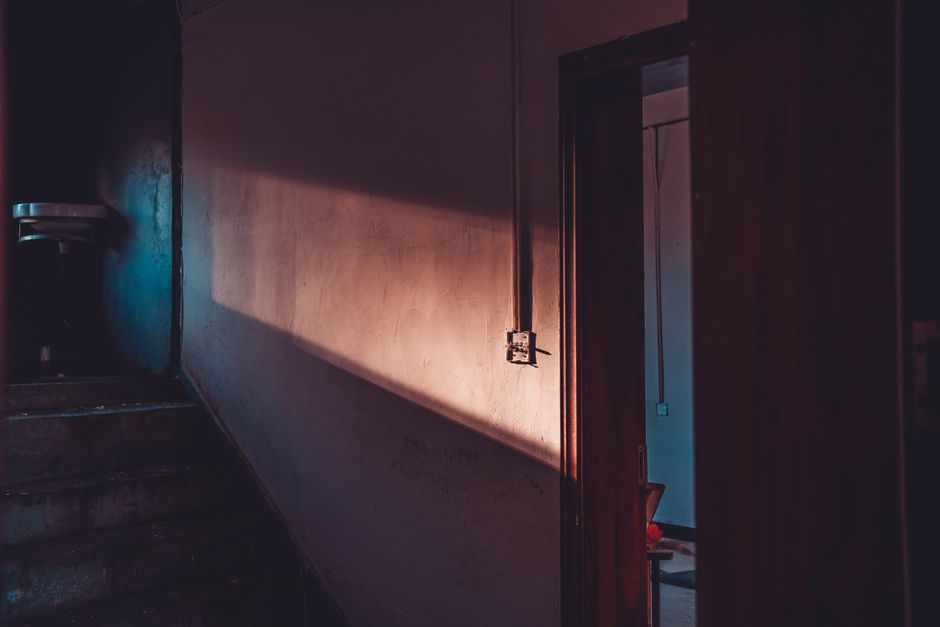
The hum came the next night, while she was crying. Low, behind the crib, out of the cold-air return grille — one of those painted-over grilles with stripped screwheads, the louvers sealed half shut, the kind of thing the landlord tells you not to touch because the ductwork is “temperamental.” The furnace was off. I checked the thermostat twice.
It wasn’t a machine sound. Machines have a floor they don’t go under. This one had a shape to it, rising and falling like a voice doing a murmur a room away, and the crying ended mid-breath on the third or fourth pass. Then the hum went on a while by itself, unhurried, over the crib, and wound down like someone finishing a chore and leaving the room.
I told Marcus at breakfast. He said bearings. He said return ducts amplify. He spends his mornings on nacelle platforms in lake wind; a noisy vent in a rented double ranked below the pilot light on his list of problems. But he caught it himself that weekend, standing in the doorway with June going red on the changing table, and to his credit he didn’t stand there long. He cut cardboard and taped it over the grille, six strips of duct tape, and moved the crib three feet to the window wall.
She cried that night from eleven to six. Not the newborn cry either — she was six weeks old by then, and it had become a voice with opinions. The cardboard didn’t touch the sound; the hum ran on behind it all night, muffled and patient, like a man waiting in a hall outside a locked door.
I peeled the tape at four in the morning. One night, I told myself. Boards in four weeks. One night of quiet and I’d study till dawn and get ahead of the flashcards.
The crying ended on the second pass of the hum. I made coffee at four-fifteen and studied against the quiet, and the quiet held like something paid for.
Easy Baby
The night waking went first. Then the afternoon fuss at the changing table. Then the car, which had been the worst of it — she’d work herself into a square shape in the carrier the second the door shut, and one Tuesday in the Blasdell parking lot she started up and stopped, between one note and the next, with the house four miles away.
I told myself she was growing out of it. Babies change every two weeks, the books all say so, and I wanted the books to be right, because I was sleeping six hours and the flashcards were going down like water.
At the two-month checkup the nurse did the heel lance, and June’s face went through the whole architecture of a cry — the inhale, the tremble, the open mouth — and no sound came out of her at all. The nurse laughed and said, “Easiest one all day,” and wrote a number on the chart, and I laughed too, on a half-second delay, the way you do.
That afternoon I bought a voice-activated microcassette recorder at the drugstore and set it under the crib.
The tapes did what tapes do. Eleven minutes of furnace and door hinges. Then a cry building, and the hum rising under it, up through the peak — and the cry ending mid-breath, clean, no falling action, no hiccup down, the way nothing alive ends a sound. And then the hum continuing. Alone. Forty minutes after she was asleep, with no cry left to answer, rising and falling in its shape, like someone rocking an empty crib and enjoying the work.
I played it for Marcus with the volume low, June asleep down the hall in the quiet. He listened to it twice with his work boots already on. He packed a duffel and went to his brother’s place, and on the porch, hands in his pockets, he said the word divorce, and I want to be fair to him: he said come with me, we’ll break the lease, we’ll figure the money out. The exam was three weeks out. The deposit was nine hundred dollars I did not have. I stayed, and it would be easy to say I stayed for the exam, and it would even be mostly true.
I passed the boards on March 14, first try, in a house where nobody raised their voice all winter. My license came in the mail that April. I framed it and hung it in the kitchen by the thermostat.
Fourth Birthday
June turned four at Houghton Park, cake in the pavilion, eleven kids and a sprinkler field. It was Marcus’s weekend, but we do the birthdays together, both of us on the same picnic blanket for two hours a year.
The sprinkler cap is older than the park staff. It got her on the third pass — a flap of sheet metal lifted by the mower — and she went down on one knee, got up, and walked to me across the grass with her face doing nothing at all. The sock had gone dark from the ankle down. The cut had parted to the length of my thumb and it was sheeting, and she held her juice pouch in one hand and stood there breathing through her nose, calm as a filing cabinet.
“That’s a big one,” I said. My hands were already on her, sock peeled, hoodie pressed to it. “June, that has to hurt.”
She tipped her head. Not at me. A little up and left, at a place in the air past my shoulder where the pavilion roof met a post, and she listened to it, the way you check a voice on a phone.
“It’s okay,” she said, patient, correcting me. “He already got it.”
Marcus drove us to the ER. Four stitches, and she watched the needle go in and out with her hands folded in her lap like a woman at a bank. The doctor told her she was the bravest four-year-old he’d had all summer, and she said thank you, because I taught her to say thank you.
I teach her the words for everything now. Hot. Sharp. Hurt. Tell me. We practice at the kitchen table, under the license in its frame: when something hurts, you come to me, you use your words, you say Mom. She can say it. She says it for scratches and dropped popsicles, at top volume, because the small ones still get past her.
The big ones go where they have always gone. Up the wall, through the grille, to whatever sits behind the paint in that room, listening on the nights I need the quiet — and I do still need the quiet, I work days at the surgical ward now, and the other nurses call me the calm one. That’s what the house sold me, and it never once lied about the price.
It just let me pick what to pay with.