The Book
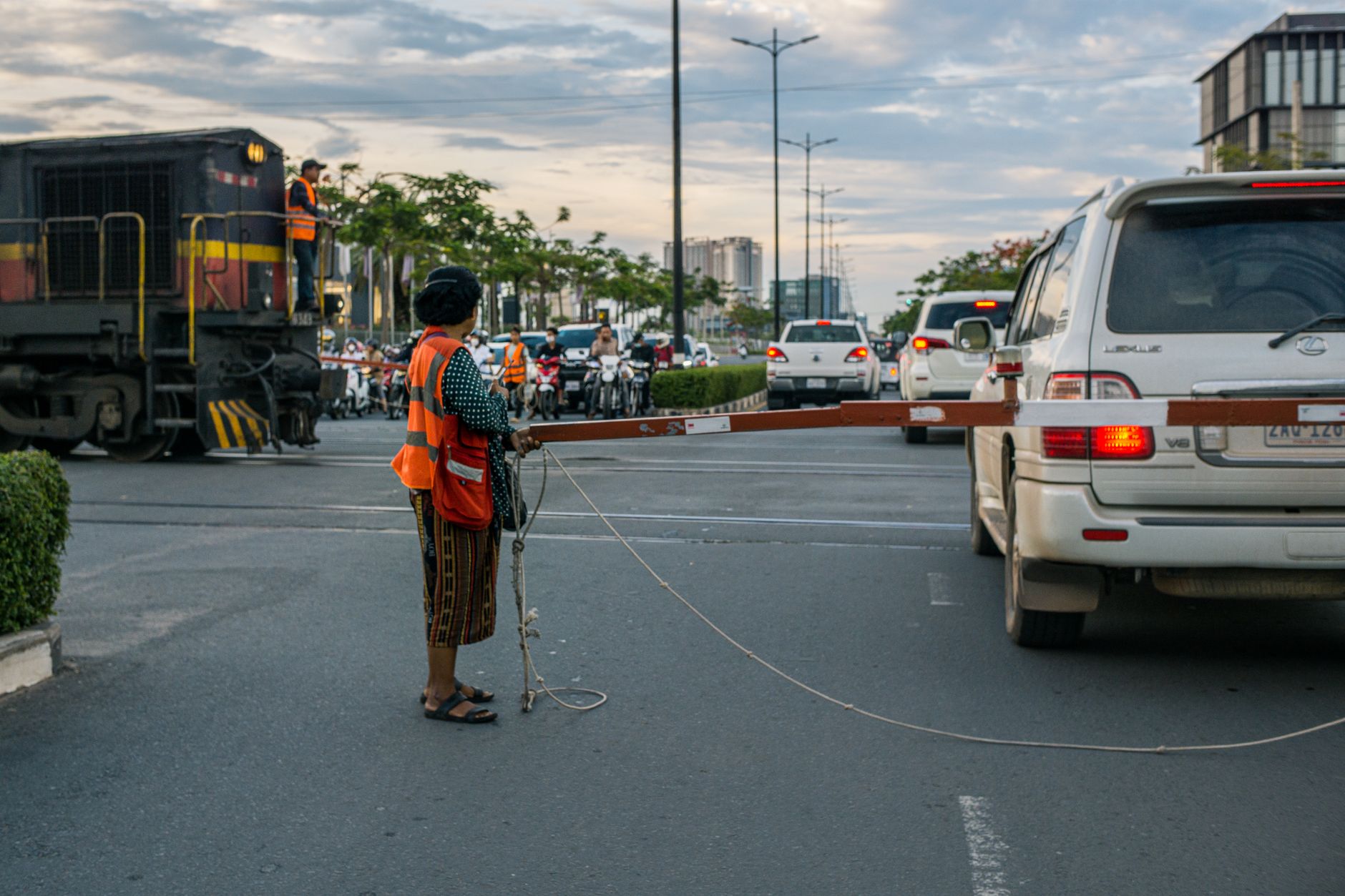
The phone in the gatehouse rang twice and stopped. That was the dispatch tell: freight coming down the Cedar Bluff line, twenty minutes out. I logged it at 11:42, set my coffee on the shelf above the radiator, and went out to crank the gates down across County Road 6.
I was twenty-six that fall, covering for a man named Kaminski while he had his heart seen to. Sugar beet season. The loaders at the co-op ran until the piles froze, the company moved the beets out at night in strings of forty hoppers, and for six weeks the crossing on County Road 6 was mine. The county never funded the automation, so a person stood there and worked it, the way a person had worked it since 1948.
The rulebook was a fat binder with a cracked spine, and most of it was ordinary. Gates down before the train, gates up after. Log the passage, log the tail lamp. But behind the tab for night movements was one paragraph typed on a different machine and stapled in, and it read:
After nightfall, where the tail lamp of a passing movement is logged WHITE and not RED, gates shall remain lowered a full nine (9) minutes past the passage of the last car. During this interval the attendant shall remain in the gatehouse with the door closed and shall record the wait as HELD. Gates shall not be raised early on any account, nor for any traffic. The road is to be considered not yet dry.
Kaminski’s handwriting filled the ledger before mine. Forty years of nights, page after page: 11:58, 42 loads, tail red. 12:40, 40 loads, tail white, held 9. Every white lamp held the full nine. All except one page in his last October, where the ink was pressed deep enough to emboss the three sheets under it, and the entry read held 8, with nothing after it. The next night’s entry started a new paragraph, as if he’d needed room to get going again.
White
The first white lamp came on a Tuesday in the third week. Forty hoppers, wallowing and shrieking, and on the last car a lamp the color of a flashlight held to a fingernail. Not red. I wrote the time, closed the gatehouse door, and started the nine minutes on my phone.
Around the fourth minute, gravel worked. Not a car — no engine, no sweep of headlights across the ceiling. Footsteps, at a walk, on the far side of the crossing, pacing a line parallel to the gates. Unhurried. Twenty steps out, twenty steps back. I stood at the window with the book against my chest and did the arithmetic a man does at such moments: deer, strung wire, a neighbor out with a dog. The steps kept their spacing like they’d been set with a gauge.
At nine minutes the sound stopped mid-stride, the way a radio stops when you pull the cord. I raised the gates. The road was empty both directions, and dry, and I drove home at shift’s end with the windows up.
Second white lamp, that Friday. This time a car came — a Corolla with a hospital parking sticker, a woman my mother’s age gripping the wheel at ten and two. I held the gates. She watched me hold them, checked her own clock, put up with it. Somewhere in minute five her head began to turn, tracking something walking beside her car that I could only hear — the same pacing, but nearer the gate arm now, on my side of the rail. In minute eight her mouth moved. When the nine ended and I raised the gates, she rolled her window down a hand’s width and told me, not unkindly, to get a different job, because the thing on the road had stopped when she’d stopped, both times she’d tested it, and had been facing her.
I found Kaminski in the phone book. He talked to me from his recliner, eight days out of bypass surgery.
“You held the full nine,” he said. Not a question.
“Both times.”
“Then you’ve done the job.” A long breath down the line. “It paces the closed road. The road’s shut, so it walks where it’s allowed. Nine minutes is how long the crossing takes to set up behind a white lamp. Like concrete. That’s the only way I can put it.” He paused there long enough that I checked the call was still live. “I held eight once.”
He didn’t say what happened after. I didn’t ask. We said goodnight.
Six Minutes
The third white lamp came on a Thursday with real traffic: the Corolla woman, a feed truck, and behind them a dually with in-state plates that had been laying on its horn since the last car of the train cleared the asphalt. The driver got out before I’d finished writing the hour. Big man, canvas coat, forearm tattooed like a cattle chute, standing in my light hollering that he had stock to water, no time for company games, and where did I get off.
Minute five. The pacing had started, on the rail side. Unhurried.
I want it in the record that I knew what I was doing. That’s the part I can’t put down clean. I didn’t panic and I didn’t forget the paragraph. At minute six I went out and cranked the gates up ahead of the dry, because a big man was in my light and two vehicles were idling, and I chose them over a paragraph typed in 1948.
The Corolla waited. I looked right at her and she shook her head once and put her car in park. The feed truck waited. The dually did not. It came through the crossing at a farmer’s furious clip, empty trailer slapping, and in my mirror its lamps lit the road behind it, and for two beats of that mirror there was a longer shadow in the spray of its headlights than any truck casts. Upright. Mid-crossing. Moving off after it at a walk.
The other two crossed behind it with the road barely dry and got through. I wrote held 6 in the ledger, because I am not also a liar.
The dually made the county paper on Sunday, four lines under the crop prices. Found in a field approach two miles east, engine ticking, doors shut, radio on, no driver. His wife told the reporter he’d been late watering stock. They dragged the pond on the neighboring place and walked the ditch with dogs, and the dogs worked in circles, like something had crossed the field on foot and then quit being anywhere.
Red
I got the winter contract. Kaminski didn’t come back, and the book is mine now.
The white lamp shows every night. Not most nights — every night, last car, without fail, and I hold the full nine, door closed, and log it HELD. The pacing has stopped keeping to the far side. It works my side of the rail, then the far side, then a stretch down the centerline of the road itself, like a man walking a fence line he’s come to own. Some nights, in minute seven or eight, the steps pause at the gate arm, and there’s a sound like a palm laid flat on the wood, testing it.
The company paved the crossing in the spring, and the asphalt took a seam that never cured. It stays soft there, a hand’s width wide, right where a tire track crosses the rail, dark like wet. The county set a cone on it, then a plate, then gave up. Cars go over it fine in daylight. At night I’ve stopped taking the road home; I walk the two miles along the ballast to my truck at the co-op, because out on the road, with no gates anywhere near, there’s no telling what hour of the wait a car is driving through.
The paragraph hasn’t changed. The road is to be considered not yet dry. What it doesn’t say — what forty years of Kaminski’s entries say between their lines, and what that one pressed-through page says plain as an embossing — is that the nine minutes was never for the trains or the cars.
It’s the only thing standing on that road between it and the county.