The Seventeen Forty-Eight
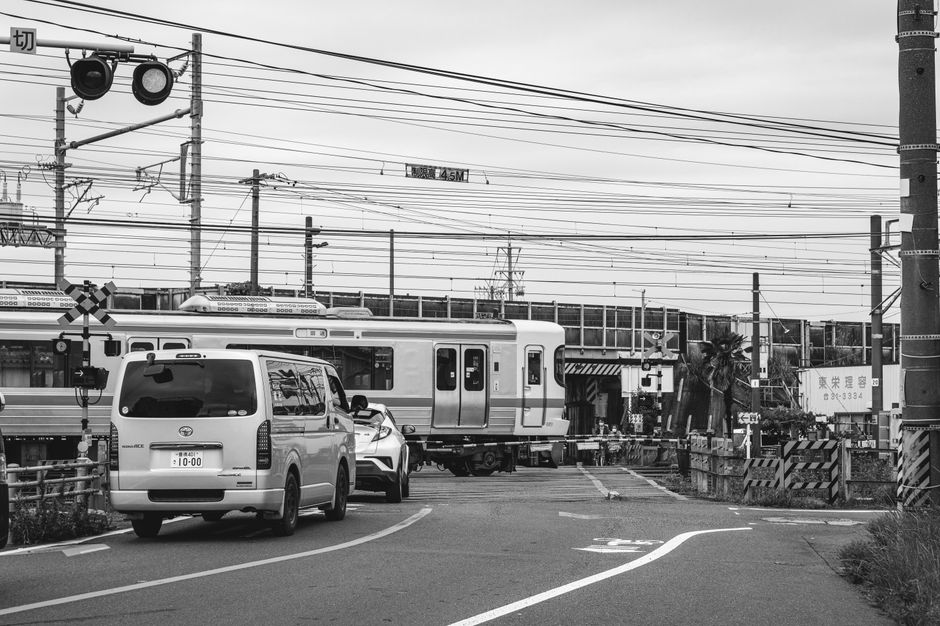
Three years standing, and my body knew the service better than the timetable did. Seventeen minutes out of Central the floor tips under everyone at once, and four hundred strangers lean into the Merefield bend like one animal turning. Nobody holds the rails. In the full press you cannot fall: the crowd is mutually buttressed, shoulder socketed into shoulder, and it takes the curves for you and hands you back to yourself on the straight.
I want to set the arrangement down honestly, because it matters to everything that came after. A standing crush runs on a bargain. You give the mass your weight, all of it, and the mass does your balancing — and in return you hold up your share of whoever is next to you, a stranger’s coat seam against your jaw, wet wool, somebody’s briefcase riding between your knees. Nobody agrees to it. Everybody keeps it. The man who will not lean is a known type, disliked on sight, gripping the rail with both hands and taking a little of the carriage’s honesty away with him every night.
My father was dying up the line at Daneford. Sundays I went to him; the rest of the week I stood on the seventeen forty-eight with a paperback I never opened. There was a transfer on the books to the branch office at Daneford — six weeks off, if I held the desk together, if the ward sister’s phone calls kept missing me at lunch. Six weeks of routine. That was the whole of my ambition, and it did not seem like much to ask of a train.
Merefield Bend
The change, when it came, was small enough to be roadworks.
The lean started arriving early. Half a second, then a full second — the press tipping into the bend ahead of the bend, and me held inside it, braced before the lurch instead of after. Then it stopped being early and started being exact. I lurched, one Tuesday, a real stumble off my standing foot, and the press took it like a mould taking plaster. No hand grabbed me. No shoulder shifted. The four coats around me were the same four coats as any other evening, and my stumble went nowhere at all, absorbed an inch under my own centre, as though the space I occupied had already been told.
New ballast, I thought. Different stock. Three years of legs doing what three years of legs do. I was thirty-six and I rationed my worry for things with better claims on it.
Then it began to anticipate stumbles I had not had. Leaford crossing, where the emergency stop lived — the whole carriage thrown forward, every strap swinging — and a shoulder pressed into my back one inch tighter a breath before it happened, and faces around me unmoved, unbothered, nobody’s to claim. The oldest stock still wore its enamel plate over the doors:
STANDING PASSENGERS SHOULD HOLD THE RAILS PROVIDED AT ALL TIMES
That instruction was older than I was, and in three years I had never seen one soul obey it.
Off-Peak
So I tested it, the only way a standing passenger can. I dropped my weight at Merefield — knees loose, a fall in miniature, nothing any onlooker would read as deliberate. Caught. I dropped it again the next evening. Caught, and not caught as a bag is caught, snatched at the last inch, but caught as a word is caught by a sentence that was waiting for it. The press had begun to count me, and it counted me in before I finished falling.
Half past seven, June, off-peak: a carriage with three other passengers, spaced well down, strangers to me and to each other. I stood free at the doors. The bend came, and the catch came with it — a pressure laid along my back from the door side, where nobody stood, the nearest man five seats away with both hands full of newspaper. I sat down for two stations with my heart going like a bird in a box, and got off early, and walked the last mile and a half.
Off the train, the rhythm stayed on. The queue at the cash point swayed and I swayed with it, leaning for a curve the pavement never took. At the photocopier I corrected my balance for Merefield and put a hand on Jean’s desk to do it. When Jean steadied my elbow at the coffee urn I snatched my arm away — from Jean, who had covered for me through two flu seasons — and the face she made was worse than a telling-off. I said sorry. I did not explain. There was nothing in my vocabulary yet for I think I am being kept.
And there was the woman at the doors. Every service, a different coat, the same place. Her sway ran half a beat behind the carriage’s, like dubbing, like film with the sound wrong, and in the densest press nobody leaned on her, ever, and she braced no one. She stood in the crowd the way a post stands in a river. I worked out what she was on a Thursday between Leaford and Merefield, and made myself stop working it out before I finished.
Uncounted
The transfer came through on the Tuesday. That same night the ward sister rang at half nine, and I understood the two of them — the paperwork and the phone call — to be one instruction, and that I would be on the last stretch of the line in time or not at all.
My final evening on the service, I withdrew. Curve by curve, the whole way out of Central. At the first bend I kept my own spine and gave the press nothing. At Leaford I unlocked my own knees, myself, alone. At Merefield I stood in the crush like a post in a river, hands in my pockets, taking my own weight back at seventeen minutes past six of a July evening — and the mass let me go the way a column of figures lets a line out: struck through, uncounted, cold arriving at every point where a stranger’s coat had been.
At my station the crowd opened early. Nobody moved, exactly. The gap simply preceded me down the carriage, and I walked out of my three years through a corridor of people who had held me up.
Clear Air
No stranger has touched me since.
Understand it plainly, because I have had the years to check it. The barrier rush at Central parts around a person-shaped gap that moves at my speed. On a bus packed to the straps there is a hand’s width of clear air at my shoulder that stays through every bend of the ring road, though the standing passengers swing into each other on both sides of it like laundry. At my father’s funeral my great-aunt reached for my hand, and her hand stopped an inch short of mine, fingers curling as if over a rail, and she looked at the hand, and then at me, and said nothing, in the way my family had all learned by then to say nothing. The pews were full. There was space beside me the whole way through the service, and my brother’s boys stood at the back rather than sit in it.
I still ride trains. I stand where I like, often by the doors, sometimes within a coat’s breadth of the woman with the delayed sway, who never looks at me and whose gap I can feel beside my own, two posts in a moving field. At Merefield the carriage leans and everyone leans with it, four hundred strangers turning as one animal.
I lean too. On my own, in my foot of clear air, with my hands in my pockets.
Which is what I asked for. It is what I asked for.